



The 2026 Asia-Pacific Marketing Academy Annual Conference (APMA2026) was held from 5 to 8 June 2026, under the innovative “One Conference, Two Places” model across the Macao Special Administrative Region and the Guangdong-Macao In-Depth Cooperation Zone in Hengqin. Initiated by the Guangdong-Hong Kong-Macao University Alliance for Marketing, and recognized by the International Congress and Convention Association (ICCA), APMA2026 is an internationally renowned academic conference with broad influence in the Asia-Pacific region. It was co-hosted by the Macau University of Science and Technology (MUST), the Guangdong-Hong Kong-Macao University Alliance for Marketing, and the Macao Association of Convention, Exhibition & Tourism Sectors. The event was organized by the School of Business (MSB) at MUST and the Macau University of Science and Technology Innovation Technology Research Institute, with Zhuhai Da Heng Qin Development Co., Ltd. As co-organizer.
The opening ceremony was held on June 6 at the Hengqin International Hi-Tech Innovation Park. Welcome remarks were delivered by Professor Pang Chuan, Vice-President of MUST; Mr. Chen Xinhua, Chairman of Zhuhai Da Heng Qin Development Co., Ltd.; and Professor Wang Haizhong of Sun Yat-sen University, Chairman of the Guangdong-Hong Kong-Macao University Alliance for Marketing. Professor Sheng Ni, Dean of MSB, and Professor Liu Chengkun, Director of the Institute for Sustainable Development at MUST, also attended. The ceremony was moderated by Associate Professor Zheng Lei of MSB, who served as Chair of the conference.
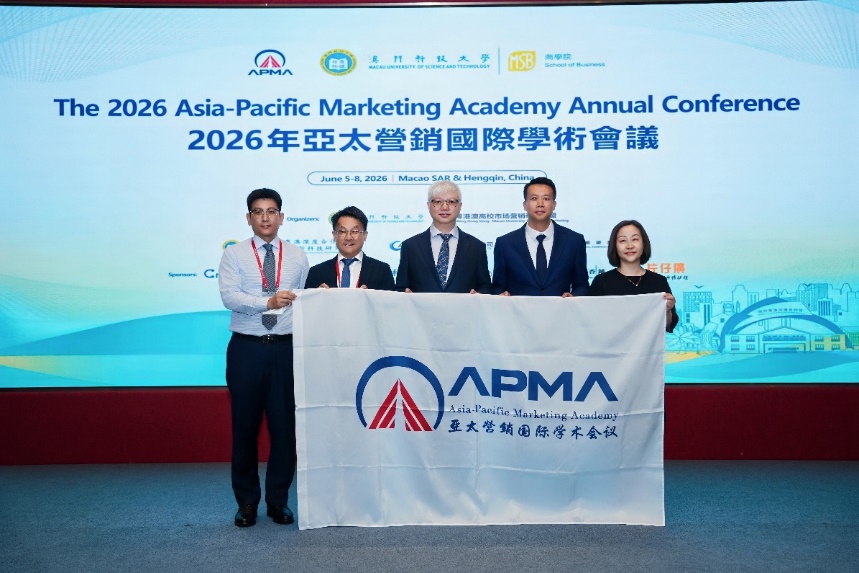
Group photo (from left): Zheng Lei, Wang Haizhong, Pang Chuan, Chen Xinhua, Sheng Ni
Multiple academic and industry keynote speeches were delivered on the same day. From 7 to 8 June, the conference continued at the MUST campus in Taipa with forums, workshops, parallel sessions, and other activities. Scholars from 15 countries and regions, including China, the United States, the United Kingdom, Japan, New Zealand, Singapore, and the United Arab Emirates, participated. Delegates represented more than 150 universities and research institutions, totaling over 500 attendees. The conference demonstrated a high degree of internationalization and extensive academic exchange.
The program focused on cutting-edge issues at the intersection of artificial intelligence and marketing science. Keynote speakers included Professor Yubo Chen (Tsinghua University), Professor Thomas Kramer (University of California, Riverside), Professor Leonard Lee (National University of Singapore), and Professor Julio Sevilla (University of Georgia). Their lectures combined theoretical depth with practical insights. Special sessions included journal paper development workshops and marketing technology workshops. More than 50 parallel forums were held, presenting over 300 academic papers and showcasing the international frontiers of the marketing research.
Adopting the “One Conference, Two Places” format, APMA2026 linked resources between Macao and Hengqin. The organizing team coordinated cross-border transportation and customs guidance, connecting key venues and ports to ensure a seamless agenda and provide attendees with a “single trip, dual venues” experience. Through institutional innovation and resource coordination, the conference promoted the efficient flow of academic resources and innovation between Macao and Hengqin, fostered academic cooperation and industry-university-research integration, and contributed to the deeper integration of the Guangdong-Macao In-Depth Cooperation Zone in Hengqin.
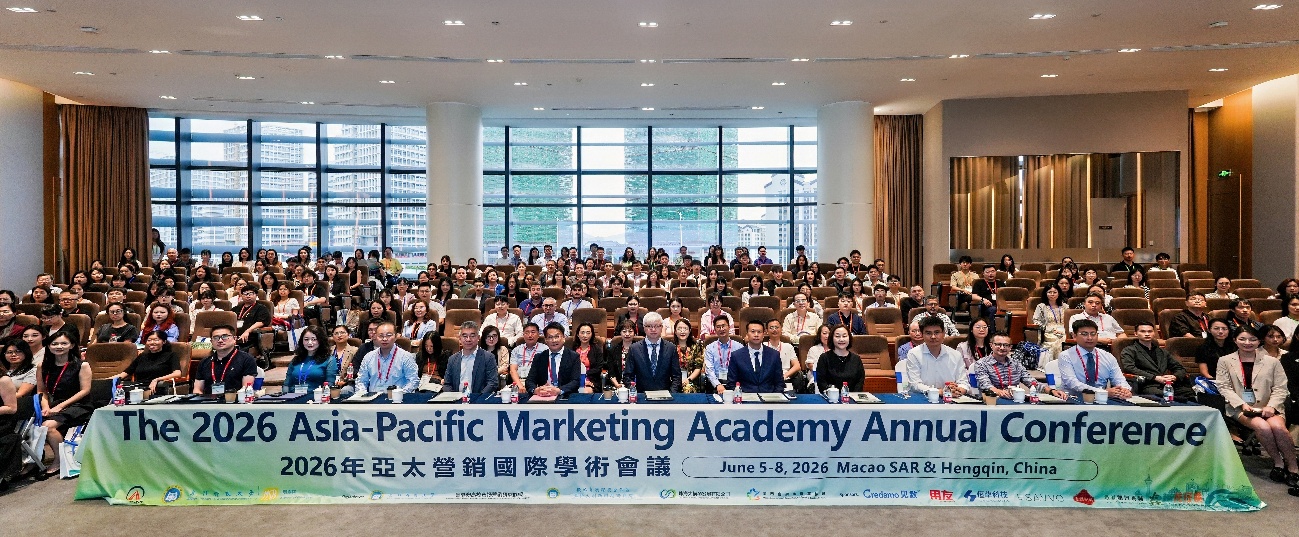
Group photo of the participating guests
The conference emphasized the simultaneous advancement of academic research and industrial practice, focusing on practical issues such as enterprise digital and intelligent transformation, data-driven AI marketing, organizational change, and the implementation of digital and intelligent marketing innovation. It facilitated closer integration between research outcomes and application scenarios. Special events strengthened dialogue within the Asia-Pacific marketing academic community, injecting new momentum into efforts to improve the quality of business education in regional universities. With a focus on industrial practice, forums such as the Digital and Intelligent Marketing Entrepreneurs Forum and the Tourism and Leisure Industry Forum enabled entrepreneurs to discuss marketing transformation in the digital era and share practical experiences in digital innovation.
(Contributed and reviewed by Associate Professor Zheng Lei, format reviewed by Helen Kam)

