

The research project “Key Technologies for High-Reliability Low-Attitude Logistics Unmanned Aerial Vehicles (UAVs)”, jointly submitted by the School of Business (MSB) and Macao Institute of Smart City (MISC), Macau University of Science and Technology (MUST) in collaboration with the University of Brasília, has recently received funding under the International Collaborative Research category from the Macao Science and Technology Development Fund (FDCT). This project marks MUST’s first successful application in the field of low-altitude economy and smart logistics, representing a significant step forward in technological innovation for cross-border low-altitude logistics.
The project actively responds to the policy direction outlined in the Report on the Work of the Government 2025, which emphasizes further promoting the safe and healthy development of emerging industries, including the low-altitude economy. To address the “last-mile” logistics bottlenecks encountered during the in-depth integration of Guangdong and Macau, the research team will develop low-altitude logistics UAVs with high wind and corrosion resistance, as well as intelligent obstacle-avoidance capabilities. These UAVs are expected to provide solutions for smart logistics, emergency response, and urban air mobility.
This project brings together research expertise from Macau, Brazil, and Mainland China. The team includes Chair Professor Felix Tung Sun Chan and Professor Huajun Tang (Principal Investigator) from MSB, Professor Chi Tin Hon (Co-Principal Investigator) from MISC, the TransLab team from the University of Brasília, and the team from the School of Aeronautics at Northwestern Polytechnical University. This cross-regional, interdisciplinary collaboration model provides a solid foundation for technological innovation. Professor Huajun Tang, the Principal Investigator, stated that, “The project team has established a comprehensive R&D roadmap. We will progressively advance tasks such as the verification of the hybrid-electric propulsion system architecture, performance design optimization, and the establishment of low-altitude flight safety assessment mechanisms, ultimately completing flight testing and verification.”
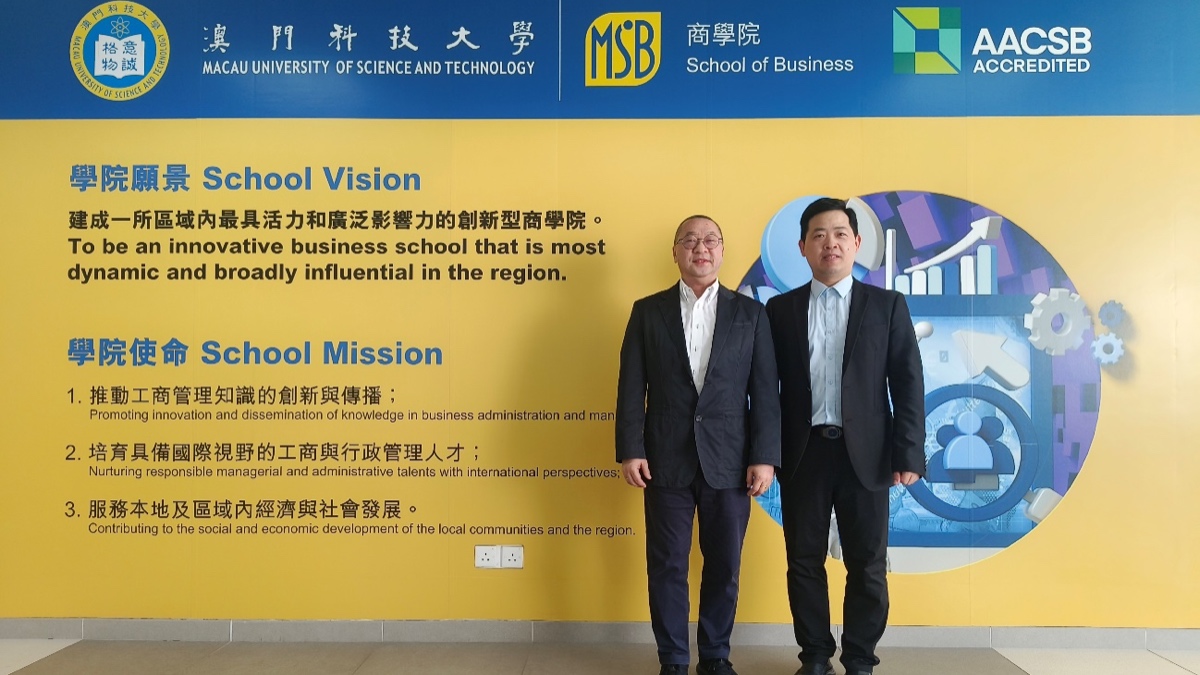
Chair Professor Felix Tung Sun Chan (left) and Professor Huajun Tang (right)
The successful establishment of this project reflects MUST’s notable advantages in technological innovation and international cooperation. Taking this as the starting point, while with the support of the University and MSB, the team will innovate, explore, enhance the scientific rigor of research, deepen interdisciplinary integration, and strengthen talent development; and strive to achieve new breakthroughs in theoretical construction, cutting-edge exploration, social service, and discipline development, contributing scientific and technological strength to the moderate diversification of Macau’s economy and the construction of the Guangdong-Hong Kong-Macao Greater Bay Area.
(Contributed and reviewed by Professor Tang Huajun, format reviewed by Helen Kam)

