



Dr. Jing Kecen, Assistant Professor at the School of Business (MSB) of Macau University of Science and Technology (MUST), has published a paper titled “Expressways, Market Access, and Industrial Development in China: Using Walled-City Panel Instrumental Variables of Minimum Spanning Tree” online on 18 December 2025, in the Journal of Development Economics, a leading journal in development economics. Assistant Professor Jing is the first author of the paper, her main research areas include urban and regional economics, transportation economics, and industrial development. Currently, she focuses on issues related to infrastructure construction in China, the real estate market, and the urban ecological environment. This research also marks the first time that MUST has published in the Journal of Development Economics, highlighting the University’s outstanding research capabilities in the fields of business and economics. Founded by Elsevier in 1974, the Journal of Development Economics is an internationally recognized top journal in the field of development economics. It is renowned for its rigorous peer review and high academic standards, with an average acceptance rate of only 5% – 8%, placing it in the JCR Q1 journal category and enjoying an excellent academic reputation and international influence.
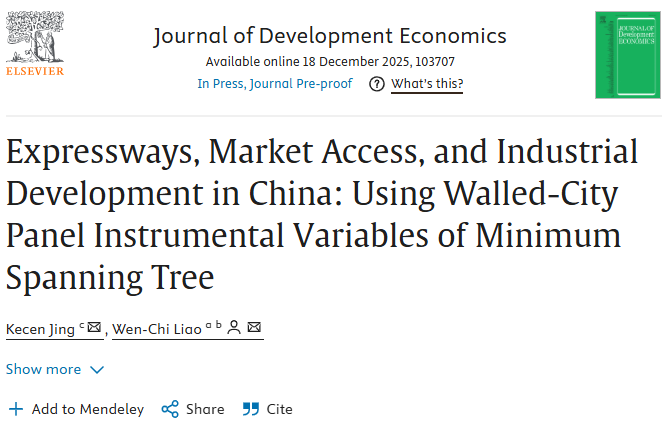
The co-author of this paper is Associate Professor Wen-Chi Liao from the National University of Singapore. The main contribution of the research lies in constructing a panel instrumental variables method that combines dynamic exogeneity with nationwide coverage. This approach breaks through the limitations of previous studies in terms of spatiotemporal scope and identification strategies, providing a solid micro-theoretical foundation and a scalable empirical analysis framework for understanding the causal mechanisms between transportation infrastructure and regional development. It offers significant policy implications for infrastructure policies and coordinated regional development in developing countries.
This study addresses the significant demand for the rapid expansion of China’s national expressway network and the upgrading of regional manufacturing. It systematically assesses the impact of the rapid expansion of the national expressway network on regional manufacturing upgrades from 2000 to 2009, providing robust empirical tools and policy implications for understanding how infrastructure reshapes economic geography by enhancing market accessibility. The research proposes an innovative identification strategy using “Walled-City Minimum Spanning Tree Panel Instrumental Variable” approach, which simulates counterfactual road networks based on the characteristics of historical walled cities. This effectively resolves endogenous issues in causal inference and achieves comprehensive coverage analysis at the county level across the nation. Empirical results show that a 1% increase in market access leads to a significant 0.28% rise in county-level manufacturing GDP, a 0.07% growth in the number of firms, and promotes capital deepening and industrial upgrading. In particular, it encourages the agglomeration of capital-intensive and high-tech industries in inland regions. However, the expansion of expressways does not show a significant impact on total factor productivity.

Assistant Professor Jing Kecen
(Contributed and reviewed by Assistant Professor Jing Kecen, format reviewed by Helen Kam)

